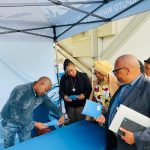
University of Eswatini (UNESWA) at the Luyengo Campus for the Climate Change Commemoration Day
April 22, 2026
VUNWE programme
May 6, 2026
Project objective
To promote integrated source-to-sea management across the Incomati and Maputo River Basins and coastal zones to ensure environmental security and inclusive livelihoods.
Strategic importance
- Regional Integration: Strengthens cooperation among the three Member States, the Kingdom of Eswatini, the Republic of Mozambique, and the Republic of South Africa.
- Global Alignment: Supports commitments to climate resilience, biodiversity conservation, and the Sustainable Development Goals (SDGs).
- Institutional Credibility: Enhances INMACOM’s visibility as a credible authority in transboundary water governance.
- Stakeholder Engagement: Mobilizes participation and ownership to ensure the sustainability of outcomes.
Project components
Component 1: Strengthening regional governance frameworks for transboundary basin management, including application of source-to-sea management approach.
Component 2: Facilitating a knowledge-based approach for source-to-sea management.
Component 3: Support basin-wide and coastal zone strategic planning and investment mobilization.
Component 4: Creating sustainable livelihoods through enhancing water, food, energy and environmental security.
Component 5: Knowledge generation, communication, and dissemination.
The GEF-8 project, funded by the Global Environment Facility (GEF) and implemented by UNDP, positions INMACOM as a regional leader in sustainable water governance.
Implementing Partners
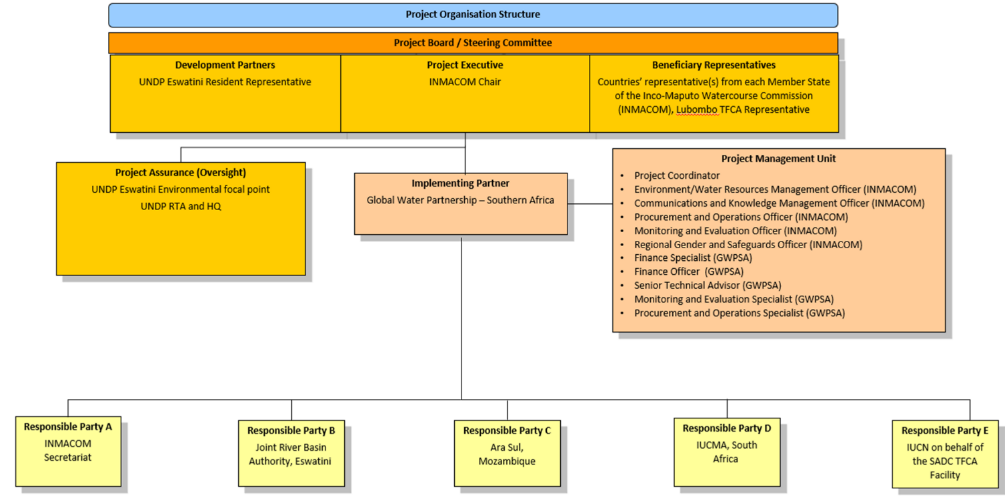
The United Nations Development Programme (UNDP), together with the Global Water Partnership-Southern Africa (GWPSA), is supporting the project "Strengthening integrated transboundary management of the Incomati and Maputo River Basins”, funded by the Global Environment Facility (GEF). As the GEF implementing entity, the UNDP provides overall oversight of the project with GWPSA being the executing agency, while INMACOM is the focal custodian of the project implementation.
Project organizational structure
Benefits of the project
- Strengthening multinational cooperation through INMACOM and the Lubombo TFCA, with co‑financing partners enhancing technical and coordination capacity to position them as a hub for aligning political and economic interests across the basins.
- All three member states, the Kingdom of Eswatini, the Republic of Mozambique, and the Republic of South Africa, will also benefit from targeted capacity-building initiatives at both regional and national levels.
- Integrate improved knowledge of transboundary aquifers into basin management, promoting the conjunctive use of surface and groundwater resources including managed aquifer recharge where feasible and advancing climate‑resilient planning across both basins.
- Support the participating countries to carry out informed policy dialogue at the basin level to address increasing water, energy, and food demands in the future and how these needs can be met in an environmentally sustainable and socially inclusive manner for the basin’s population.
- Improve water quality monitoring that reduces fish morbidity and disease, thereby strengthening livelihoods and food security.
- Support downstream agriculture, fisheries, water storage, and hydroelectric infrastructure.
- Increased financing for priority interventions, guided by the Strategic Action Programme (SAP) and its financing strategy, will strengthen water availability across the basins. This will drive long‑term economic development, enhance livelihood opportunities, and deliver targeted improvements in areas such as Maputo Bay.